The Blind Men and the Wealth Tax
On 24 June, Norway’s tax commission handed the finance minister a thick report that, on one technical question, quietly got the economics right. It proposed to scrap the patchwork of valuation discounts that riddle the Norwegian wealth tax — the rabatter that assess a primary home at a fraction of its worth, unlisted shares at book value, and everything else on its own separate scale — and instead to value everything at market, at a single low rate. To a general reader this sounds like dry plumbing. To anyone who has worked through the mathematics of wealth taxation, it is close to the whole elephant.
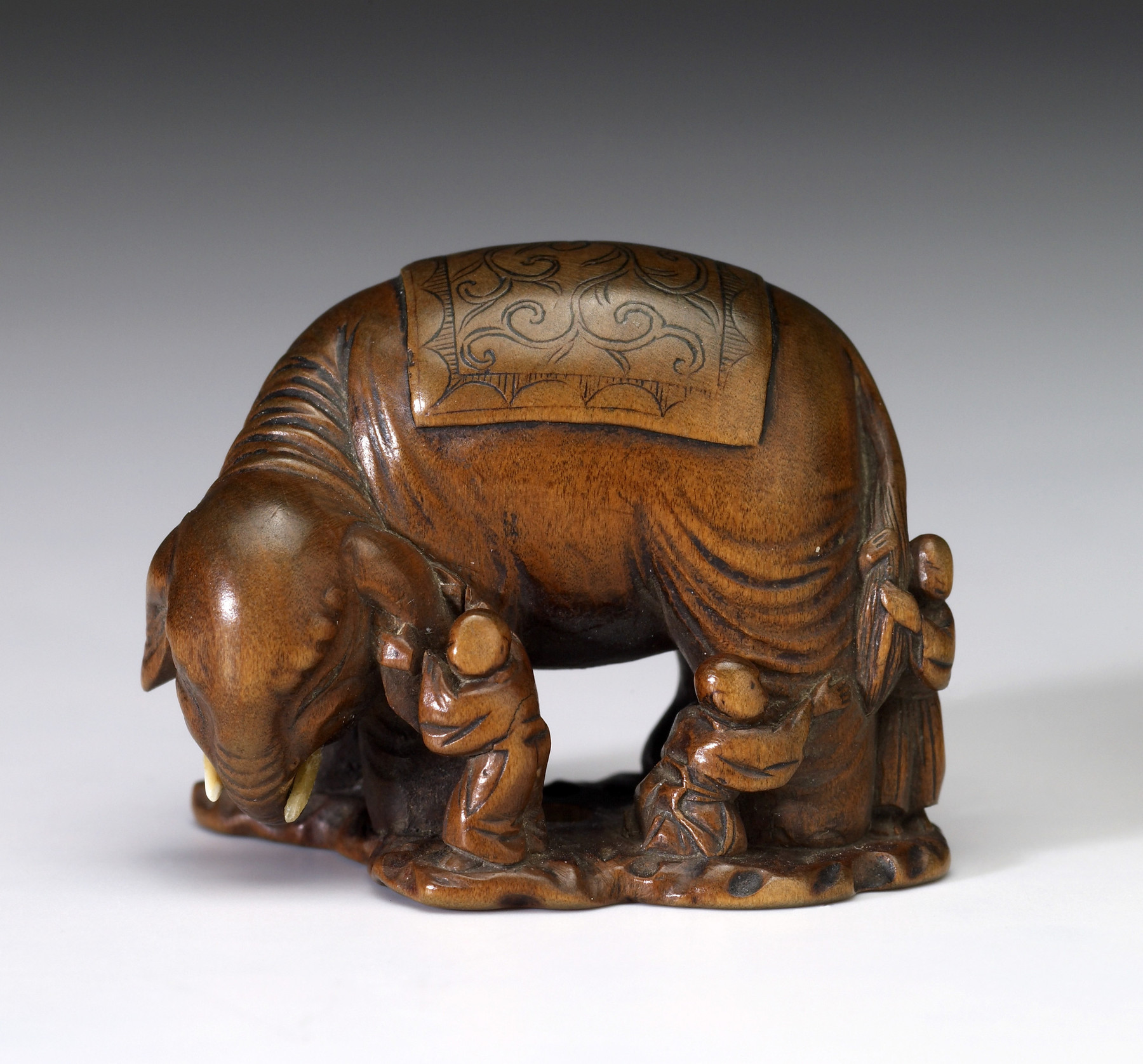
I mean that almost literally. There is an old parable, carved here in a thumb-sized nineteenth-century Japanese netsuke: several blind men crowd around an elephant, and each takes hold of a different part. The man at the trunk swears the animal is a kind of snake; the man at the ear, a fan; the man at the leg, a tree. Each is honest. Each is partly right. And each is completely wrong about the whole, because he has mistaken the part in his hands for the entire beast — and, worse, will argue down anyone who reports a different part.
The Norwegian wealth tax debate is a room full of blind men, and the elephant has been standing patiently in the middle of it for years.
What the commission actually built
A wealth tax has a reputation as a uniquely destructive instrument. It taxes the stock of wealth, not the flow of income; it nags at capital every single year; surely it must bend every decision out of shape. The surprising result — which I’ve written about before, and which sits at the centre of a neutrality framework I’ve been developing — is that a wealth tax levied at a uniform rate, on all assets, assessed at market value, doesn’t bend anything at all. It behaves like a silent partner who takes the same fixed slice of every venture you might enter. Because the slice is identical everywhere, it changes none of your rankings. Your best portfolio before the tax is your best portfolio after it. The tax is a level, not a lever.
What breaks this is not the tax but the discounts. The moment you value a holiday cabin at thirty per cent of its worth and a listed share at one hundred, you have manufactured a reason to prefer the cabin — not because it is the better asset, but because it is the more lightly taxed one. The distortion that everyone blames on “the wealth tax” is almost entirely the distortion of uneven valuation. The commission’s central sentence says exactly this, in the flat prose of a public report: skewed valuation between assets is an important source of the wealth tax’s harmful effects. Their remedy — value everything at market — is precisely the move that restores neutrality.
So the commission, starting from a hard-nosed efficiency diagnosis and no theorem in hand, reached for the one design the theory says is undistorting. They built, more or less, the whole elephant. Then the room got hold of it.
The myth about pricing
Buried in the report, two of the commission’s own members append a comment that has since been quoted approvingly in the press. It runs roughly like this: even if the wealth tax does not distort which investments a Norwegian chooses, a Swedish owner who pays no wealth tax could value the same company more highly — and so the tax “weakens Norwegian ownership” in favour of foreigners.
It is worth slowing down here, because this is the part of the elephant that is not there: a phantom limb the politics very much wants to feel.
Notice first that the comment contradicts itself inside a single sentence. Its opening clause concedes that the tax does not distort the Norwegian’s choice between one investment and another. Its closing clause then claims the tax lowers the Norwegian’s valuation of an asset relative to a foreigner’s. But if a residence-based wealth tax really did depress what a Norwegian would pay for an asset, it would depress it for every asset he might buy — Swedish, American, Norwegian alike — because he pays the tax on all of them. There would be no special reason for Norwegian companies, in particular, to drift abroad. The mechanism, taken at its word, does not even point at the conclusion it is summoned to support.
And taken fully seriously, it cancels. A Norwegian pays wealth tax on everything he owns. So the tax lowers what a given company is worth to him — but it lowers what his next-best alternative is worth to him by exactly the same proportion. When he works out what he should pay for the company, the tax shows up on both sides of the calculation and divides out. He arrives at the same price the untaxed foreigner would pay. The two value the firm identically. This is not a delicate empirical question; it is arithmetic, and it is the same silent-partner logic as before.
Here is the part that should end the argument. The comment leans for support on a recent paper by the economists Snorre Lindset and Svein-Arne Persson. That paper does contain a striking figure — at today’s interest rates, a Norwegian business owner would accept a corporate tax rate north of forty per cent to be rid of the wealth tax — and that figure is real. But it measures the burden of the tax, how heavily it sits on an owner; it says nothing about valuation. On valuation, Lindset and Persson prove precisely the cancellation above, and they write, in plain Norwegian, that their results do not support the claim that the wealth tax reduces Norwegian ownership. The authority cited in defence of the myth is, on the exact point at issue, a refutation of it. So is a second paper in the same journal issue, by Petter Bjerksund and Guttorm Schjelderup, two of the country’s leading tax economists.
There is even a twist of the knife. The one feature that genuinely makes a Norwegian and a foreigner value a company differently is the valuation discount — and it runs the other way. Because unlisted shares are taxed below their market value, a Norwegian’s after-tax cost of holding them is lower than the foreigner’s; he will, if anything, outbid the foreigner for exactly the closely-held Norwegian firms the comment frets about. The discount the commission proposes to remove was quietly favouring Norwegian ownership. Remove it and you move toward neutrality; you do not weaken something the tax was strengthening.
None of this is new, which is what makes it strange. The pricing question has been argued in the open in Norway for more than a year. During the 2025 election campaign it boiled over inside the Norwegian School of Economics itself, when two scholars in the school’s finance group publicly branded the Bjerksund–Schjelderup neutrality result a “calculation error” — “inconsistent, and simply wrong.” The result they attacked had been peer-reviewed and published in an international journal back in 2021; its authors stood by it; and when Dagens Næringsliv followed the dispute up months later, the critics conceded that they should not have called it a calculation error at all — what they really had, they said, was a disagreement with the model’s assumptions. No public correction was ever printed. The accusation travelled; the retraction did not.
So by the time the commission sat down to write, the headline result — a wealth tax does not change what a Norwegian will pay for a share — had been published, peer-reviewed, defended in the country’s main financial newspaper, and all but vindicated when its loudest critics walked their charge back. And still two members of the commission, appointed to a cross-party panel precisely for their command of tax and finance, wrote the old intuition into the report — which elsewhere cites the very paper that refutes it. They are not ill-informed; that is exactly the point. A claim that persists in the most expert room in the country, after the evidence is in and even the critics have retreated, has stopped working as a conclusion and started working as a belief. And there is a last irony in the very shape of it: the neutrality result holds precisely when assets are valued uniformly, at market value — which is the system the commission itself recommends. Under their own proposal, the objection has no ground left to stand on.
Why does it survive at all? Because it is the limb the politics wants to be holding. “The wealth tax drives Norwegian firms into foreign hands” is a powerful story, and a powerful story can survive being wrong — can survive even being refuted by the very paper hauled in to support it. This is what ideology does to perception. It does not merely limit which part of the elephant you happen to touch. It makes you grip your part and wave away the others — including the parts that aren’t there at all.
Five hands on the elephant
When the report landed, the country’s economists and tax lawyers reached out and each took hold of a part. The remarkable thing is that, the pricing myth aside, almost every one of them was honestly reporting something real. The elephant does have legs and a trunk and ears. The trouble is only that each spoke as though his part were the whole animal.
Thomas Piketty, by email from Paris, felt the fairness leg: cutting the wealth tax for the very richest while raising the consumption tax on ordinary households is, he said, “a fairly regressive tax reform.” He is right about the part he is holding. Distribution is a real leg of this elephant.
Guttorm Schjelderup — and here is the interesting case — took hold of the same leg from Bergen: the package probably eases the load on the richest one per cent, proposes no inheritance tax, and offers ordinary earners very little. What makes Schjelderup the exception in the room is that he is also a co-author of one of the very papers that proves the pricing part. He has felt two parts of the elephant and keeps them straight: in the journal he affirms that the tax is valuation-neutral; in the newspaper he argues about who ought to pay. He does not confuse the moral question with the mechanical one. Almost everyone else does.
The tax lawyer Bettina Banoun felt the valuation-base leg: revalue the growth companies on Euronext Growth at full market value and their owners are hit hardest. She is right, and the sting has a precise cause. The standard method for valuing unlisted firms systematically under-values exactly the most successful, goodwill-rich ones — a recent study of roughly eight thousand Norwegian company sales puts the typical unlisted valuation at around sixty per cent of the price the shares actually fetched. Removing the discount bites the winners. That, too, is a real and uncomfortable part of the animal.
Harald Hauge felt the competitiveness leg: even after the cut, Norway sits next door to a Sweden that levies no wealth tax at all. Also real — but notice it is a different limb entirely from the pricing myth. It concerns whether a wealthy person stays in the country, not whether a tax secretly lowers what he will pay for a share. Emigration is a genuine margin; valuation is not.
And Ragnar Torvik felt the housing leg: the proposal still leaves homeowners with large advantages, and the people it quietly disfavours are renters, who have no lobby to speak for them. True again — and again, one leg of several.
Each of these is a fair report from one position around the animal. None of them is the animal. Taken together, the debate has the exact texture of the parable: five confident descriptions that never quite assemble into an elephant, plus one description — the pricing myth — of a part that does not exist.
Seeing the whole animal
The reason the parable fits, and not merely the bland observation that “people disagree,” is that the wealth tax really does have separable parts, and the framework I have been describing is essentially a map of where each hand is resting.
Once the valuation discounts are gone, there are exactly two real margins left. One is distribution — how progressive the tax should be, set by the threshold below which no one pays and the rate above it. That is Piketty’s leg, and Schjelderup’s, and Torvik’s, and it is a genuine moral and political choice. You can believe the rich should pay far more, or rather less, and nothing in the mathematics settles it for you; the neutrality of the design is precisely what lets you turn that dial to any setting you like without bending the economy out of shape. The other real margin is residence — whether the very wealthy stay or go, which is Hauge’s leg, and which turns on exit taxes and the gap to Sweden, not on any secret repricing of assets. And there is one part the commission could not fix: unlisted shares are still to be valued by a method that undershoots the market, which is Banoun’s leg and the single genuine distortion the framework actually flags.
What there is not is a channel by which a neutral, market-value wealth tax makes Norwegians value their own companies less than foreigners do. That part of the elephant does not exist. The striking thing is that the commission built, in its core design, something very close to the neutral benchmark — and that within forty-eight hours the public conversation had broken the animal back down into limbs, with the loudest limb of all being the imaginary one.
I do not think the answer is to wish the moral debate away. Politics should argue about distribution; that is one of the things politics is for, and the netsuke’s blind men are not fools for each grasping a real part. The failure is narrower, and more fixable. It is the habit of seizing one part of a problem, declaring it the whole, and — when someone reports a part that cuts against your priors — insisting the elephant has no such part. The cure is not more conviction. It is the patience to walk around the animal.
The carver understood this better than the debate does. Look closely at the little netsuke and you notice that the one figure who could actually see — the artist — is the one who set the whole elephant, calmly and completely, in the palm of a hand.